

Mountain wines: why do we focus on the altitude of our vineyard?
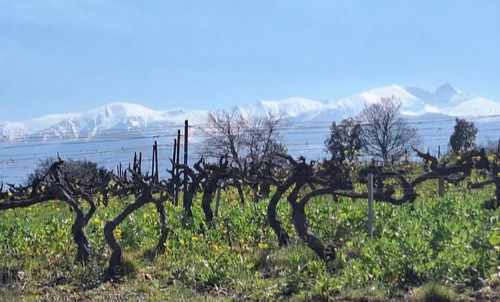
Canigou, Landmark and Inspiration
At Mas Llossanes, our vineyards stretch across hillsides facing the majestic Canigó, the sacred mountain of the Catalans. More than just a backdrop, it is a landmark, a presence that dictates the seasons and gives the estate its identity. We cultivate vines on the foothills of the massif at nearly 700 m altitude, in a luminous, wild, and demanding environment — a terroir where nature directly imprints its signature on the wine.

Altitude, a Taste Signature
Cultivating vines in the mountains is not merely an aesthetic choice: it is a stylistic commitment. Altitude brings three essential elements:
- Lower average temperatures, which preserve the natural acidity and tension of the wines. It is commonly believed that the temperature drops by 0.60°C for every 100 meters of altitude. At 700m, we enjoy temperatures that are approximately 5 to 7°C lower compared to vineyards located on the Roussillon plain.
-
Slow ripening, favoring finesse and balance over power.
The significant day-night temperature variations before harvest balance the phenolic maturity of the grapes (tannins, anthocyanins) with their technological maturity (sugars, acids). The result is full-bodied wines with refined tannins, while naturally maintaining a moderate alcohol content. -
Precise, clean, never heavy aromatics
Heat can deteriorate the aromas of grapes. More moderate temperatures prevent this aromatic oxidation phenomenon, offering us fresher fruitiness and wines that keep much better over time.
Here, harvests are sometimes decided within a day. The vines progress at their own pace, shaped by temperature variations and the intense light of the heights.
Tramontana Wind and Granitic Soils: A Living Terroir

On the estate's hillsides, the vines plunge their roots into granitic sands, a coarse sand resulting from decomposed granite, both draining and poor. This type of soil forces the plant to draw deeply, yielding straightforward, mineral, and elegant wines.
The tramontana, the emblematic wind of Roussillon, also plays a key role: it naturally purifies the vineyard, concentrates the berries, and contributes to the sensation of purity found in Mas Llossanes' vintages.
Le Pur Chasan, a Rare Expression of Altitude
If there is one wine that perfectly embodies this mountain identity, it is the Pur Chasan.
This confidential grape variety — a cross between Chardonnay and Listan — finds an ideal terroir for expression here. The altitude brings it crystalline tension, vibrant freshness, and aromatic precision that oscillates between notes of citrus, white flowers, and fresh stone.
Rare by nature, at Mas Llossanes it becomes a true manifesto: that of a vineyard that favors elegance, energy, and the clarity of its terroir.

A Viticulture of Balance
Cultivating at altitude requires humility and observation. Conditions are harsher, yields often lower, but the reward is there: bright, digestible wines deeply rooted in their landscape.
At Mas Llossanes, each cuvée thus tells a little about this mountain vineyard — between granite, wind, and light — with the silhouette of Canigou, the silent guardian of our vines, in the background.




Leave a comment
This site is protected by hCaptcha and the hCaptcha Privacy Policy and Terms of Service apply.